Take a trip to Garh Panchkot, situated next to Panchet Dam, at the base of Panchet Hill. It is as though time is waiting for you to turn each page, holding its breath. And we're here to tell you why Garh Panchkot in West Bengal should be in your next week's getaway itinerary.

Garh Panchkot: The Ultimate Guide To Unlock Wonders Of A Once Powerful Monarchy
What Makes It Awesome
Overview
Garh Panchkot Through the Ages
This location has been associated with the Singh Deo dynasty for around 1500 years. Now mostly just temple ruins, this abandoned fort represents the last vestiges of a once-powerful monarchy. "Garh" is the word for the Kashipur king's fort, and paradoxically, he constructed a temple on Panchet Hill, while "Panchkot" means "Fort of the Five Clans." This is where the name "Garh Panchkot" originates. At roughly 2100 feet, the hill itself offers a view that is absolutely jaw-dropping.
The temples are designed in various architectural styles. Temple ruins, woodlands, soaring Panchet Hill, and the Damodar River meandering underneath it are all enveloped by rich vegetation.
It is said that during a visit to Puri in the middle of the first century CE, Raja Jagat Deo of Dhar (Madhya Pradesh) had his queen give birth at Jhalda (now in Purulia, West Bengal). Local tribal chiefs discovered the infant alive after it was abandoned and thought to be stillborn. Born into a tribal family, Damodar Sekhar went on to found the Panchkot Royal dynasty in 80 CE.
When Panchet Dam was constructed, the remains of Telkupi, an old Jain centre, were flooded. Around 1600 AD, the Singh Deos are reported to have lost, albeit briefly, to Bir Hambir of the Bishnupur Raj. The area was ravaged in the 18th century by Maratha raids, known locally as Bargis. In the end, the Singh Deo family relocated to Kashipur, which is presently in the Purulia district.
Fun fact: Joseph David Beglar authored an essay titled 'Panchet' after visiting Panchkot in 1862. In 1872, poet Michael Madhusudan Dutta, who worked as an estate manager for the Singh Deo dynasty, also resided at Garh Panchkot. Panchkot Giri. Panchkotoshyo Rajosree, and Panchkot Giri Biday Sangeet are the three poems he wrote on Panchkot while he was there.
Must See Attractions
In and near Garh Panchkot, there are a few sites worth seeing. The ruins are the most visited of all. But we have a list of must-see attractions for you.
Garh Fort
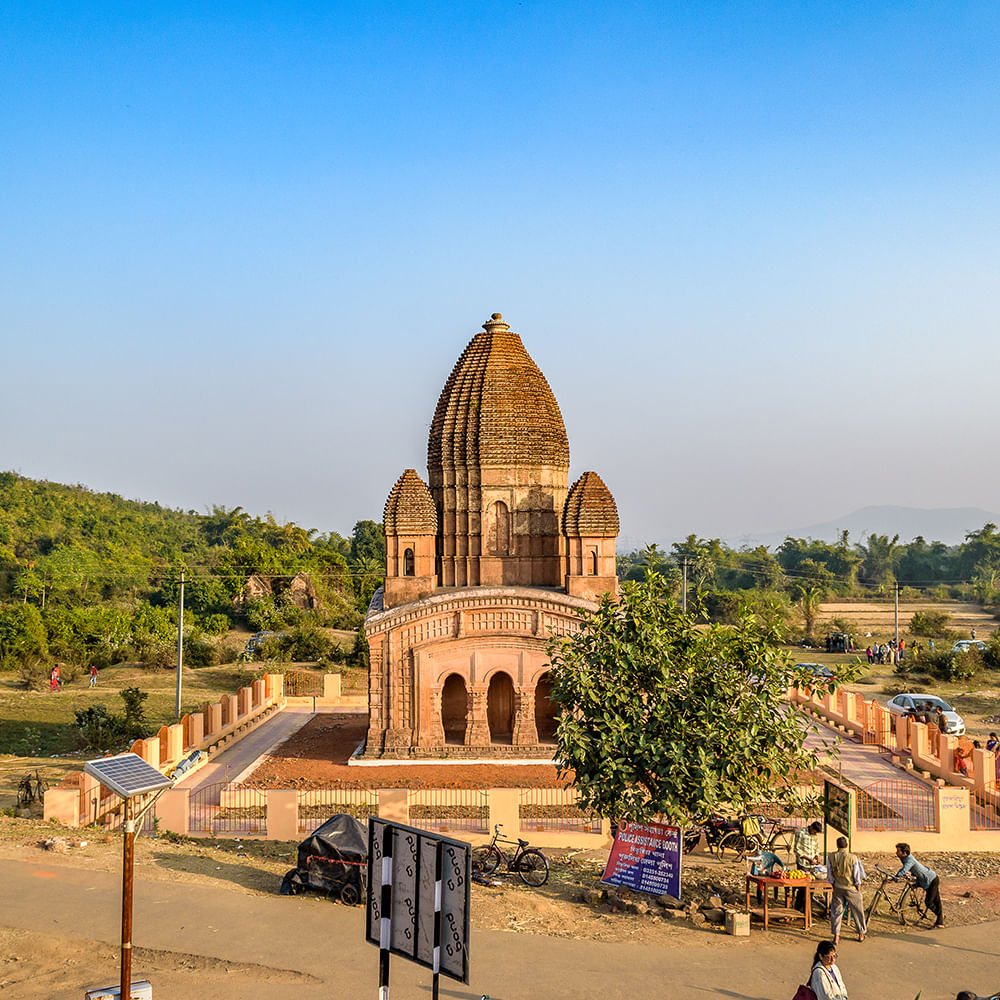
As silent witnesses to the dynasty's growth and collapse, the remains of the Singh Deo Dynasty's Garh Fort, which is situated in the southern foothills, and a collection of temples, remain intact still. Poor maintenance has left the place in a state of disrepair. But there's something to watch out for on the drive here. One's heart and spirit are touched by the charming vista of rural Bengal and its narrow, winding lanes.
To the left, you'll see a guard tower and shattered walls. A number of temples may be found all throughout the place, the most prominent of which is the recently refurbished Pancharatna temple. Because of the influence of Chaitanya Mahaprabhu in the 16th century, the Rajput kings of the Panchkot dynasty, who were Shaktism's believers, constructed temples that were influenced by Vaishnavism.
There are two architectural styles to see—the Jorbangla style from Bishnupur Gharana and an older form made of enormous stone blocks. Gorgeous terracotta work graces the arches and pillars of the Pancharatna temple, which is of the Jorbangla style.
Panchet Dam
The Panchet Dam was built across the Damodar River in the Jharkhand district of Dhanbad. You can drive there in 15 to 20 minutes from Garpanchkot, and it's an attractive location to watch the setting sun slowly fade into the evening. With a concrete spillway, the Panchet Dam is one of the biggest earthen dams. Enjoy a boat trip in the stunning 4,232-square-mile lake that was created by the dam.
Adi Kalyaneswari Temple
Since its founding in 1377, tens of thousands of devotees have come to Paschim Tirat to visit Adi Kalyaneshwari Temple, a revered shrine in a desirable part of Asansole. But why? Simply to find spiritual comfort under Adi Shakti.The sole place of worship in the Garh Panchakot region where regular puja is still performed is the temple, which is likely where the goddess was originally worshipped.
Aarti sessions are held daily in the morning, afternoon, and evening, and after they are finished, the people are treated to mouthwatering bhog prashad.
Maithon Dam
Maithon Dam on the Baraker River, in tandem with the encompassing Maithon Lake, is an excellent destination to go sightseeing, particularly around the time of year when the Shimul flowers are in bloom. It is 22 kilometres from Garpanchkot.The dam, which was constructed in 1957 as part of India's First 5-year Plan, is 15,712 feet long, 165 feet high, and 35 feet broad, with a total area of 65 square kilometres. It is home to the first subterranean power plant in Southeast Asia, producing 60 MW of electricity every hour.
Considered one of India's most exquisite dams, Maithon Dam is often referred to as "Koyalanchal (Coal Belt) ka Kashmir." In the middle of Maithon Lake sits Spoon Island, a little island that mimics an upside-down spoon. Boats can easily reach the charming island, but because it is home to wild creatures, it is not suggested to descend without a guide.
Baranti Lake
The small village of Baranti is 12 kilometres from Garh Panchkot. With Gorongi Hill, Panchkot Hill, and Biharinath Hill all around, the village is surrounded by incredible natural splendour. Actually, the huge lake, dubbed Baranti Lake, is a water reservoir that is part of the Ramchandrapur Medium Irrigation Project. A popular destination for hill and jungle trekking because of its natural setting, the area is still being developed as a tourism destination.
Joichandi Pahar
Joichandi Pahar is around 30 kilometres from Garh Panchkot. This peaceful hill is perfect for trekking and rock climbing, and there aren't many people there. Birds chirping, vibrant palash flowers, and verdant forests make up the natural environment. Joichandi Temple and a Hanuman Temple are located at the summit, but yes, there are 300 stairs to ascend. The vista from above? Well worth the effort.
It was used to film some of the most famous scenes from Satyajit Ray's renowned Bengali film Hirak Rajar Deshe. If you're a Ray fan through and through, you'll recognise the location!
Ajodhya Pahar
The rocky Ajodhya Hill Range is 120 kilometres from Garh Panchkot and would take roughly three hours if you can tolerate the rough roads. It has the highest mountain, Gorgaburu, and is a part of the Eastern Ghats and Dalma Hills.
Renowned for winter retreats, it's ideal for hiking, rock climbing, and pursuing waterfalls such as Bamni Falls, Lower Dam, and Upper Dam. The backdrop consists of a variety of animals, including elephants and leopards, as well as the verdant Sal and Segun forests. This area has everything for adventurers and nature enthusiasts!
Charida Village
You will reach Charida, also known as Mukhosh Para or Mask Village, after a short 20-kilometer ride. It is the location of Purulia Chhau mask magic! Bright, enormous masks created by 150 families of artists. These masks play a crucial part in the traditional folk dance of Chhau.
Top Stays In Garh Panchkot
Although there are a lot of hotels and resorts in Garpanchkot, the Panchet Residency and the nature resorts run by the West Bengal Forest Development Corporation are noteworthy.
Panchet Residency
With its 15 acres of magnificent property, Panchet Residency is the quintessential eco-friendly resort.Bookings can be made online at Panchet Residency. This resort, which is located at the base of Panchakot Hill, has all the amenities of a five-star establishment, including air-conditioned rooms, a dining hall, electric generators, and lush green lawns and parking lots with views of the surrounding hills.
Luxury and comfort come together at Banjara Huts or Village Telkupi, where you may stay in sophistication. Visualise spacious cottages with LED TVs, minibars, room heaters, hot water, and an inviting dressing area. Enjoy delicious Indian cuisine while dining, and if you're feeling adventurous, reserve a tour or guided walk at incredibly low prices---INR 2000 for trekking and INR 600 per day for a guide.
Time: 12:30 PM - 10:30 PM
Price: INR 3,500 - INR 5,500
Contact: 080 6918 1880
Google Rating: 4.4/5
Garpanchkot Prakriti Bhraman Kendra
They have air conditioning, TV, a canteen, and an intercom. Online reservations can be made at www.wbfdc.net. Only AC rooms are available, and they vary in price and quality. Proper 24-hour air conditioning and water supply with willing and able to assist employees. It is possible to spend your vacation within the area without needing to travel elsewhere, in the midst of nature, surrounded by vegetation, in silence and tranquillity. The food is freshly prepared, served, and tastes delicious.
Time: Check-in time is 11 AM
Price: INR 1,500 - INR 5,500
Contact: 033 2335 0064
Google Rating: 4.4/5
How To Reach
By Road: The Durgapur Expressway and National Highway 114 will take you there in around 4-5 hours. For comfortable travel, you can just take a private vehicle or hire a taxi.
By Train: Take a train to Asansol, which takes close to two and a half hours, and then drive or hail a cab to Garh Panchkot, which is about 20 kilometres away.
By Bus: You can take a regular bus from Kolkata to Asansol, where you can then hail a local cab.